
 By lara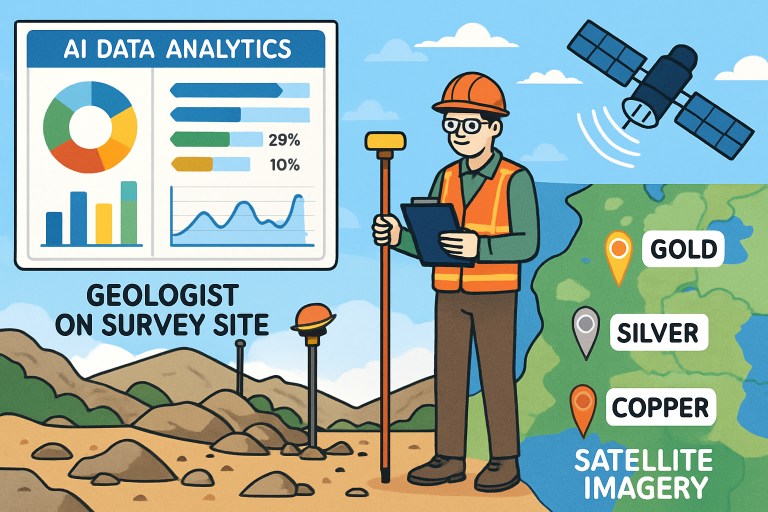
- Artificial Intelligence (AI) is revolutionizing mineral exploration by analyzing complex geological data to identify potential deposits.
- Advanced ore-sorting technologies are improving recovery rates and reducing environmental impact.
- Hydrometallurgical techniques offer environmentally friendly alternatives to traditional extraction methods.
- Satellite-based remote sensing is enabling the detection of mineral resources from space.
- Deep-sea mining presents new opportunities and challenges in the extraction of precious metals.
- AI in Mineral Exploration
- Advanced Ore-Sorting Technologies
- Hydrometallurgical Techniques
- Satellite-Based Remote Sensing
- Deep-Sea Mining
- Conclusion
The search for gold, silver, and copper is experiencing a technological renaissance, driven by an industry-wide push for more innovative methods and responsible practices. Today’s explorers are turning to advanced tools and digital intelligence to uncover new deposits, minimize operational risks, and steward the environment more effectively. For organizations and investors looking to participate in emerging gold exploration projects, understanding these breakthrough techniques is essential.
Industrial-scale mining has traditionally relied on physical surveys and extensive manual labor. However, the integration of artificial intelligence, novel chemical processes, and space-age sensing now sets a fresh standard for discovery. These tools enhance both the efficiency and selectivity of exploration, helping mining companies stay ahead of regulatory requirements while appealing to socially responsible stakeholders.
This transformation is reshaping the competitive landscape for precious metals. Miners can now leverage previously unimaginable datasets, automate extraction decision-making, and even identify resources from orbit.
Artificial Intelligence is redefining how geologists approach mineral discovery. Powerful algorithms now combine machine learning with advanced geophysical tools, such as ambient noise tomography (ANT), allowing researchers to sift through terabytes of survey data. By modeling how sound waves travel through the earth, ANT identifies zones of anomalous density or structure—prime clues for mineral presence.
Combining ANT with deep learning systems makes mineral prospectivity models more accurate, enabling the isolation of high-potential targets with greater precision and speed. AI systems also assess complex patterns hidden within geochemical and geological records, giving exploration teams a distinct advantage in challenging environments.
The next wave of ore-sorting depends on state-of-the-art sensors that can detect metals quickly and with meticulous discrimination. Technologies such as X-ray fluorescence (XRF) and near-infrared spectroscopy (NIR) are revolutionizing the separation of mineralized ore from waste rock—long before it enters the processing plant. By automating this screening, operations can realize higher recovery rates while cutting costs and drastically reducing energy and water usage.
Recent advancements harness AI to continually learn and optimize the sorting process, responding in real-time to changes in ore type or mineralogy. Trials in North America and Australia show up to a 20% boost in gold yields, indicating a clear advantage over conventional batch-based approaches. This transition is also helping operators shrink their environmental footprint, in line with pressing calls for sustainable mining.
Traditional extraction methods, especially those that rely on cyanide and mercury, are under increased scrutiny for their environmental harm. Hydrometallurgy—using water-based solutions and often less toxic alternative chemicals—offers a safer way forward. Techniques such as thiosulfate leaching and bioleaching use eco-friendly reagents or natural microorganisms to extract gold and other precious metals from ore.
This shift not only reduces the risks of catastrophic spills but also enables mining in jurisdictions where traditional methods are restricted or heavily regulated.
Remote sensing from orbit has extended the frontiers of exploration to the planet’s farthest reaches and most inaccessible regions. Companies now leverage satellite platforms equipped with Atomic Mineral Resonance Tomography (AMRT) to scan both terrestrial and marine environments for hidden mineral signatures. This capability is similar to the technology NASA employs for planetary prospecting, but adapted for commercial-scale Earth operations.
Satellite data can be layered with ground geological surveys and AI analytics to pinpoint deposits previously masked by vegetation, snow, or urban sprawl. This marriage of earth observation and computational insights dramatically increases the likelihood of success while minimizing costly fieldwork and environmental disturbance.
Interest in deep-sea mining is growing quickly as onshore reserves of key metals plateau. These resources are invaluable for the technology manufacturing industry, especially as demand for batteries and renewable energy infrastructure soars. According to the World Economic Forum, while the potential of these minerals is significant, sustainable deep-sea mining remains highly contentious, with only exploratory licenses currently issued and researchers emphasizing the need for rigorous environmental safeguards and transparent international agreements. Continuous data from multidisciplinary studies is helping guide the regulatory landscape as global attention focuses on deep-ocean stewardship.
Advanced technologies are fundamentally altering the way precious metals are found and extracted. From AI-driven data analysis to green extraction techniques and satellite-enabled prospecting, these innovations help miners balance commercial prospects with environmental stewardship. As the industry’s standards rise, embracing these tools is not only advantageous for project success but also critical for maintaining a social license to operate in the years ahead.
 Micheal